Can Queensland’s construction sector deliver in the Olympics lead-up?
Can Queensland deliver the huge pipeline of construction work, including Olympic projects, planned over the coming years? That was the topic of the inaugural Club Hibernia QLD event at the Port Office on 30 September. Club Hibernia pitches itself as a network of construction sector professionals, particularly Irish professionals, although Irish nationality or ancestry isn’t compulsory.

The panel and MC: Caitlin Shields, Hannah Tohill, Gene Tunny, and Paul Emmett
The panel discussion was timely, as the newly established Queensland Construction Portal estimates Queensland will spend $174 billion on major projects from 2025-26 to 2029-30. I was honoured to be on the panel alongside Caitlin Shields of Mitchell Brandtman and Hannah Tohill from McNab Property. Paul Emmett from Built ably MC’d.
I was asked the first question about Queensland’s construction industry capacity to meet upcoming demand. I replied that, theoretically, it could, but in practice it will be extremely challenging. Relevant facts I presented included:
- Queensland has an economy that generates over $500 billion in economic activity each year; and
- Queensland’s construction activity has been higher in the past than it is now–for example, consider that in 2013-14, largely due to the Curtis Island LNG project, heavy construction activity was $62 billion (in today’s dollars), double the $30 billion it was in 2025-26 (according to ABS Engineering Construction Activity, Table 2).
We’ve ramped up our capital expenditure a lot before (Figure 1), but is this time different? We may not be as successful this time, and my fellow panel members were certainly concerned. Concerns included accommodation availability and shortages of skilled workers. Questions include:
- Can we house the FIFO or interstate construction workers we need–will workers want to live in ‘dongas’ as many did during the last big construction boom in Queensland?
- Can we make up for the projected peak shortage of 35,000 construction workers (CSQ’s estimate reported by ABC News) with migration, when competing projects interstate (e.g. Victoria’s Big Build and Hobart’s AFL stadium, among others) are competing for them?
- Will the Olympics face significant industrial action, particularly as the finish line approaches, and costs blow out, or venues aren’t completed in time, as happened in Montreal in 1976?

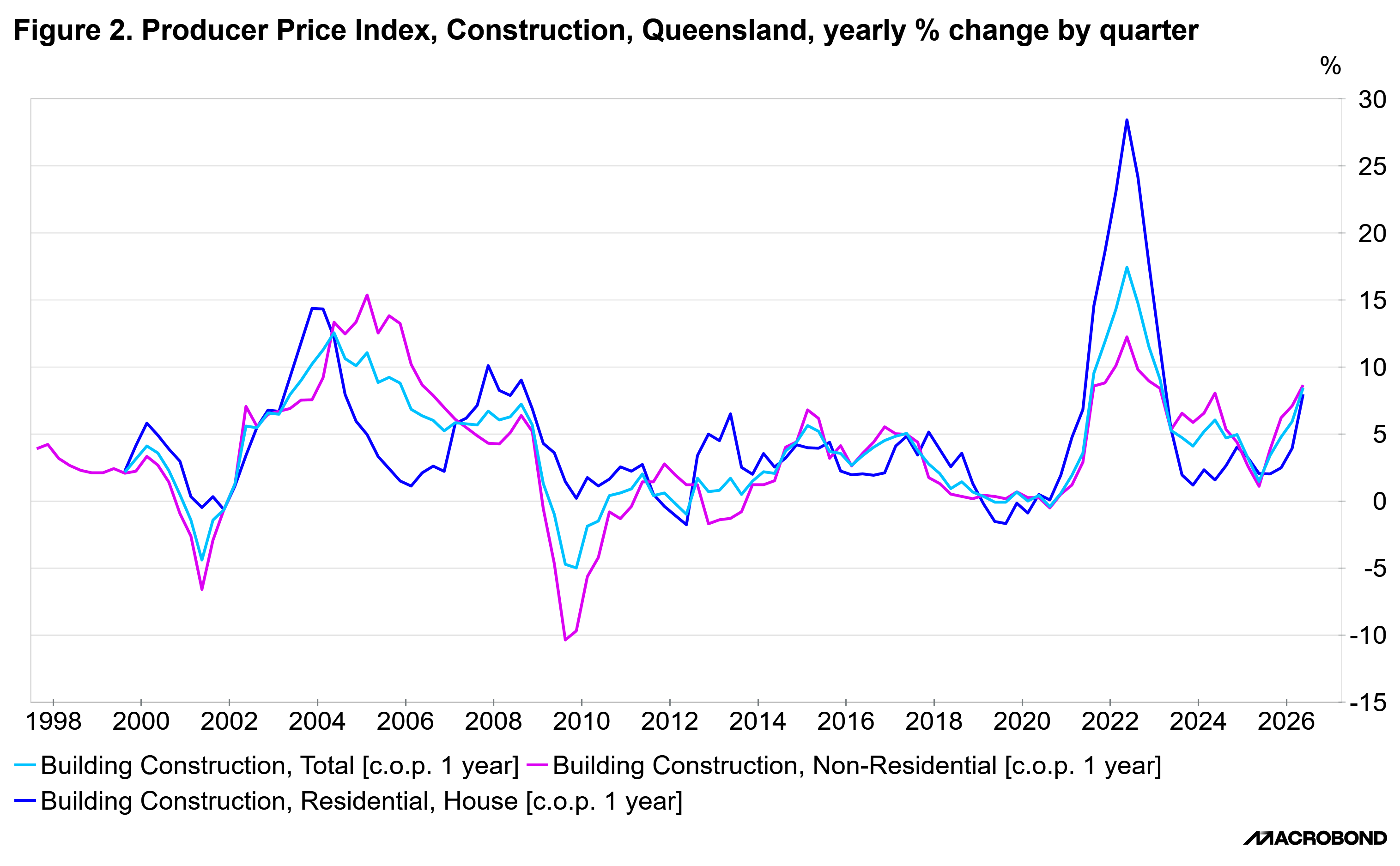
I suspect we will face severe supply constraints, which will delay many projects and cancel some altogether. One way the market will adjust is through higher input prices, as it has in the past. Input prices have been highly volatile (Figure 2), particularly in recent years due to disruptions from COVID, the Ukraine war, and now the Iran war, which has pushed up fuel costs. But even in calmer times, such as the early to mid-2000s, building construction prices spiked, with yearly increases of 10-15%, as demand outstripped supply at previous prices.
The lack of skilled workers will be a major constraint. At the event, I reflected that Australia may have made a mistake around the 1980s by encouraging so many people to study at university rather than pursue trade occupations. I remember my friend Troy’s father telling us in the late eighties, when we started high school, that we should get a trade, even if we wanted to go to university, because there would always be work and we could always fall back on it. He was a wise man.
Gene Tunny
Director Adept Economics
Published on 27 October 2026. For further information, please get in touch with us via contact@adepteconomics.com.au or by calling us on 1300 169 870.