Economic Impacts of Art Fairs and Galleries
Art fairs and galleries are increasingly recognised as powerful economic drivers, not just cultural assets. Across Australia and globally, they attract visitors, generate additional income, and support creative industries.
US$60 billion global art market
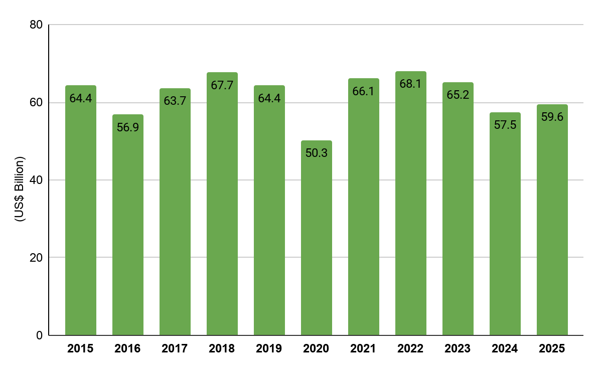
The global art market grew by 4 per cent in annual terms in 2025, with total sales reaching approximately US$59.6 billion, following two years of decline (Figure 1). Sales are showing signs of structural rebalancing, with sales continuing to stabilise after the pandemic’s volatility and the immediate post-pandemic period. This includes a shift back toward in-person channels and stronger performance in more established market segments, underpinned by robust demand for established artists.
Figure 1. Sales in the Global Art Market 2015-2025
Source: Art Economics (2026, p. 21)
In Australia, major art fairs are gaining prominence, particularly in cities such as Melbourne, where events are attracting growing national and, to a lesser extent, international audiences. For example, the Melbourne Art Fair (MAF) reached artwork sales of $16.4 million in 2026 (10.8% higher than in 2025) and 20,987 visitors, with strong growth in VIP participation. At the same time, regional galleries are strengthening their role as anchors of cultural tourism and local economic activity.
The Melbourne Art Fair
Our recent work supporting the MAF (2026 and 2025) demonstrates that large-scale art events can be rigorously evaluated. The MAF 2026 generated a substantial economic impact, with an estimated $18.0 million in direct spending from non-local visitors and exhibitors (23.3% higher than in 2025), rising to $30.6 million when broader visitor expenditure is included (21.0% higher than in 2025).
The direct economic estimates are based on spending by visitors not residing in the Melbourne Metropolitan area who attended the art fair and for whom attending the art fair was the primary or significant reason for visiting the city (i.e., this group is defined as primary visitors). The MAF 2026 welcomed 3,894 primary visitors, up from 2,656 in 2025.
This engagement highlights a key insight: cultural assets that attract non-local visitors can deliver substantial economic benefits.
Why economic analysis matters
For art fairs and galleries, economic evidence is increasingly important. Stakeholders are often required to demonstrate value in a competitive funding and investment environment. Economic assessments can support:
- Funding submissions and grant applications;
- Strategic planning and business cases;
- Stakeholder engagement and advocacy; and
- Policy development at local, state, and national levels.
At the same time, it is important to recognise that economic impacts are only part of the broader value of cultural institutions. Galleries and art fairs also contribute to community well-being, cultural identity, and the creative economy. A robust analysis acknowledges both measurable economic outcomes and wider social benefits.
The bottom line
The evidence suggests that art fairs and galleries can generate meaningful economic contributions, particularly where they attract visitors from outside the local area. However, outcomes vary depending on scale, location, and audience engagement.
Published on 20 October 2026. This article was prepared by Adept Research Economist Arturo Espinoza. For further information, please get in touch with us via contact@adepteconomics.com.au or by calling us on 1300 169 870.