It’s not just Canberra: state spending and the inflation problem
Last Tuesday, the Reserve Bank lifted the cash rate to 4.6 per cent, a 15-year high, and, beyond the expected economic impacts, created a political problem for our leaders. Federal Treasurer Jim Chalmers received many questions about the federal government’s contribution to inflation, and Queensland Treasurer David Janetzki received at least one question about his state government’s contribution. The day after the rate hike, at the first National Press Club address held in Queensland, the Queensland Treasurer said the “domestic capacity pressures” worrying the RBA were the federal government’s responsibility.
The Brisbane Times asked for my opinion on the role of the states in contributing to inflation (Qld treasurer washes hands of responsibility for rate hike), and it reported my comments as follows:
Former federal treasury official and Brisbane-based director of Adept Economics Gene Tunny said the states were “obviously” adding to the total amount of demand in the economy.
“There’s no denying that,” he told this masthead.
“Queensland on its own is one state, so it’s the states collectively that are most relevant to the overall national inflation and, in aggregate, they do pack a punch.”
State spending is over $400 billion annually, which is substantial, though lower than federal government spending of around $600 billion (excluding grants to the states), based on 2024-25 figures. Given the scale of their spending, states can clearly have a macroeconomic impact.
Incidentally, I’ve been pointing to the contribution of state spending to inflation since the last term of the previous Queensland Government, as I did in this report for the Australian Institute for Progress in 2024:
Queensland Government Spending: Implications for Fiscal Sustainability and Inflation
The states are now the main borrowers
For most of the past two decades, the Commonwealth ran the bulk of the public sector’s deficit, which tells us the public sector’s net injections of money into what economists call the circular flow of income. That pattern has reversed, however. The chart below shows net lending (+) or borrowing (-) by the Commonwealth general government and the states combined.
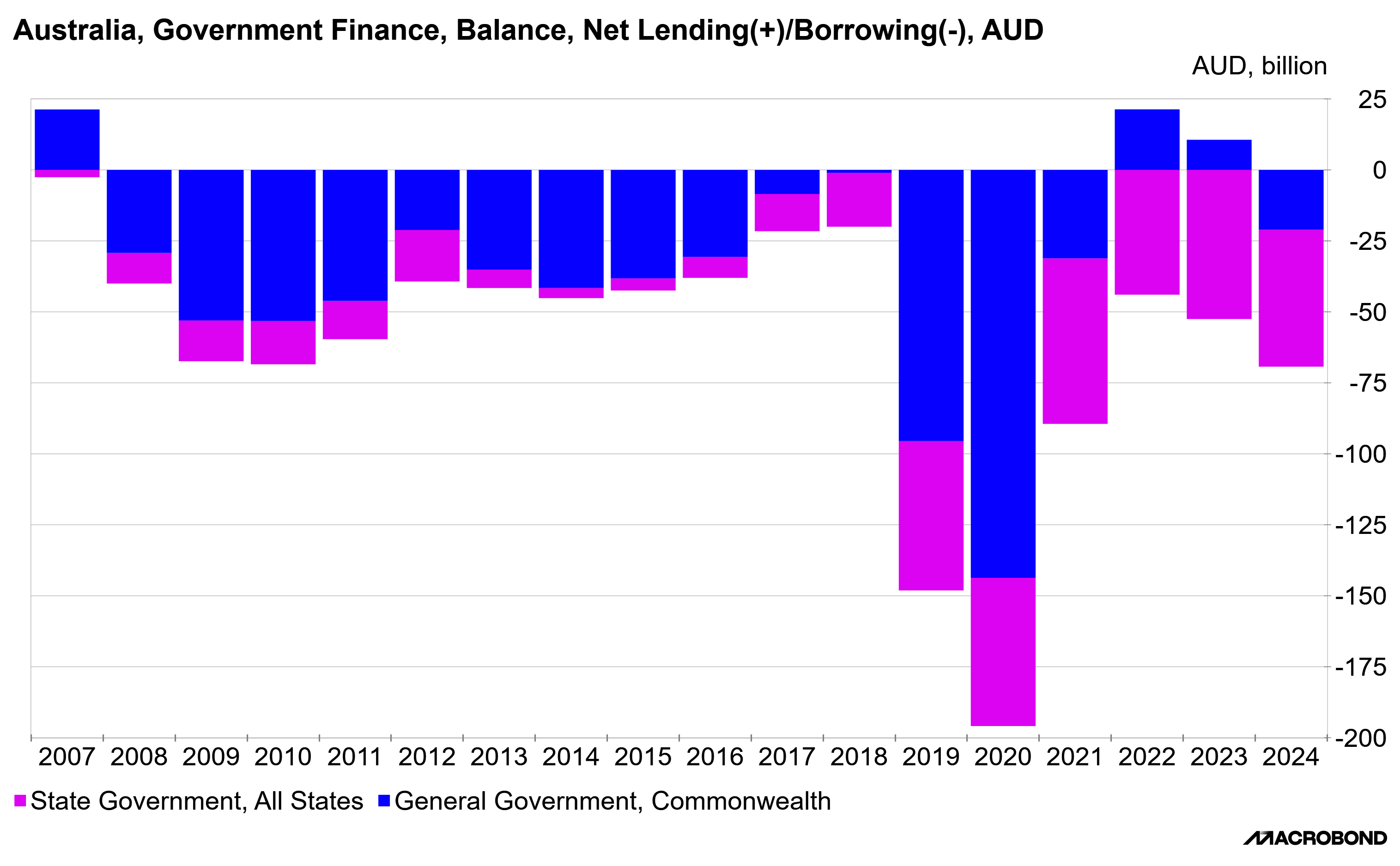
Note: Australian government net lending(+)/borrowing(-), $ billion, financial years ending June of the year after the label (e.g. the 2024 bar is 2024-25). Source: Macrobond.
In 2022-23 and 2023-24, the Commonwealth ran surpluses, while the states borrowed an average of $48 billion a year. In 2024-25, the Commonwealth returned to deficit, with net borrowing of $21 billion, but the states borrowed more than twice that, close to $50 billion. For three years running, the states have been the bigger source of public sector borrowing.
Why it matters for inflation
When a government borrows, it is spending more than it takes in, and that adds to total demand. The RBA doesn’t care which level of government the spending comes from. As Governor Michele Bullock has put it, the problem is that desired spending is outpacing the economy’s capacity to supply it.
The states are running deficits largely to finance new infrastructure. That spending is in the construction sector, which is already one of the most capacity-constrained parts of the economy. Public works compete with housing and private sector projects for the same workers and materials, pushing up costs across the economy.
Queensland is a good example. The June budget forecast $55 billion of fiscal deficits over the next four years, with debt rising from over $142 billion in mid-2026 to $216 billion by mid-2030. S&P Global has just downgraded the state’s credit rating from AA+ to AA, citing deficits driven by Olympic infrastructure spending and rising borrowing costs, among other budget pressures.
Both levels of government are responsible for inflation
The Commonwealth isn’t blameless. It is back in deficit, and its spending adds to demand too. Both the Commonwealth and the states must take responsibility for inflation, although ultimately inflation is the RBA’s KPI. If governments push up aggregate demand beyond the economy’s capacity and that adds to inflation, the RBA will need to respond with higher interest rates than otherwise.
Gene Tunny, Director, Adept Economics
Published on 6 October 2026. For further information, please contact us at contact@adepteconomics.com.au or call us on 1300 169 870.