Why Copper Prices Soared: AI, Electrification and a Slow Supply Response
Copper prices have surged in recent years, as the chart below shows. Demand is booming, while supply can’t respond quickly.
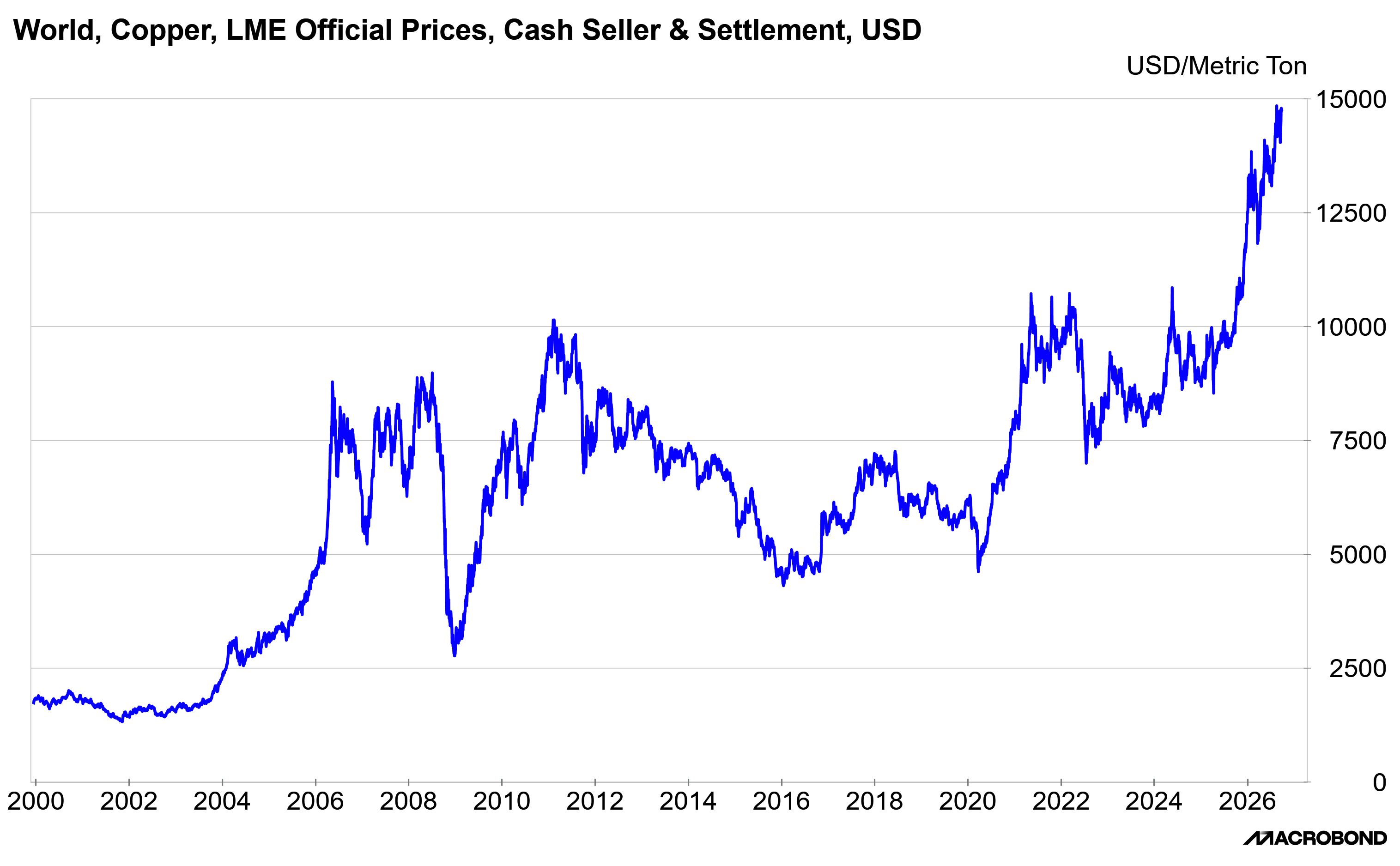
As I discussed recently on an Australian Taxpayers’ Alliance livestream, I started looking into copper prices after reading about thieves stripping copper from street lights in Melbourne. I started wondering what was driving up copper prices and making stripping copper from street lights an attractive proposition for criminals.
AI, electrification and the demand for copper
The International Energy Agency (IEA) expects copper demand to remain strong because of electricity networks, electric vehicles, construction, industry and data centres. In its Global Critical Minerals Outlook, the IEA projects copper demand to increase by around 7 million tonnes by 2040.
Copper is central to electrification. It is widely used in electric vehicles, renewable-energy infrastructure, electricity grids and other electrical equipment.
Artificial intelligence is adding another source of demand. AI may seem like a largely digital revolution, but it has a substantial physical footprint. Data centres require buildings, electrical equipment, cooling systems and, above all, enormous amounts of electricity.
In the livestream, I mentioned Anthropic’s proposed $30 billion-plus data centre in Queensland’s Western Downs. According to reports discussed in the clip, the facility could ultimately require power on a scale comparable to the consumption of more than a million households. Whatever the final numbers, it illustrates the sheer scale of infrastructure investment accompanying the AI boom.
Why isn’t supply keeping up?
Ordinarily, high prices encourage producers to increase supply. The problem with copper is that supply is relatively unresponsive in the short term.
Many major copper deposits are mature, ore grades are declining, and more rock must be mined and processed to obtain the same amount of copper. This means greater requirements for energy, water, labour and capital, and hence higher production costs that affect mine viability.
The IEA estimates that the average grade of copper mined globally has fallen by around 40 per cent since 1991. It also notes that only 5 per cent of copper deposits discovered over the past 35 years were discovered during the last decade:
Copper prices have hit record highs, but smelters face mounting strategic pressures – Analysis – IEA
Then there is the long time required to develop a new mine. Exploration, feasibility studies, environmental approvals, community consultation, financing and construction can stretch over many years. Major copper projects can take a decade or longer from discovery to production. The IEA puts the average discovery-to-production period at about 17 years.
Approvals, political risk, water availability and infrastructure constraints can all add further delays. These issues matter because copper production is concentrated in a relatively small number of countries and major mines.
Recent disruptions have tightened the market further
On top of these structural constraints, several large mines have suffered significant disruptions.
These include the continued closure of Cobre Panamá, problems at Grasberg in Indonesia, and disruption at Kamoa-Kakula in the Democratic Republic of the Congo.
Prices are sending a signal
The long-term challenge remains significant. In its Global Critical Minerals Outlook, the IEA forecasts a 25 per cent copper supply gap in 2035.
However, copper prices need not rise indefinitely. High prices themselves encourage investment, substitution, recycling and more efficient use. As the adage goes, the cure for high prices is high prices.
What copper prices are telling us today, however, is that the world wants much more copper, while bringing additional copper to market is slow, expensive, and uncertain.
Gene Tunny, Director, Adept Economics
Published on 28 September 2026. For further information, please contact us at contact@adepteconomics.com.au or call us on 1300 169 870.