Why Sustainable Pay Growth Depends on Productivity Growth
In the first episode of the ESA Queensland Young Economists podcast Markets & Motives, Productivity Commission Chair Danielle Wood highlights a fundamental insight of economics: sustained increases in real wages ultimately depend on productivity growth.
At 2:08 in the conversation, Danielle notes:
…productivity growth is really the only way we get sustainable improvements in wages and incomes over time. So why does the average Australian today have income three times higher, work less, have better health than the average Australian in 1960? It’s because we’ve had extraordinary growth in our productivity.
This relationship is sometimes overlooked in public debate. Calls for higher wages are understandable, especially during periods of rising living costs. But unless workers are producing more value per hour, attempts to lift wages across the economy tend to run into hard economic constraints.
Why productivity matters for wages
Productivity measures how much output is produced for each hour worked. When productivity rises — because of better technology, skills, capital investment, or improved business practices — firms can afford to pay workers more without raising prices.
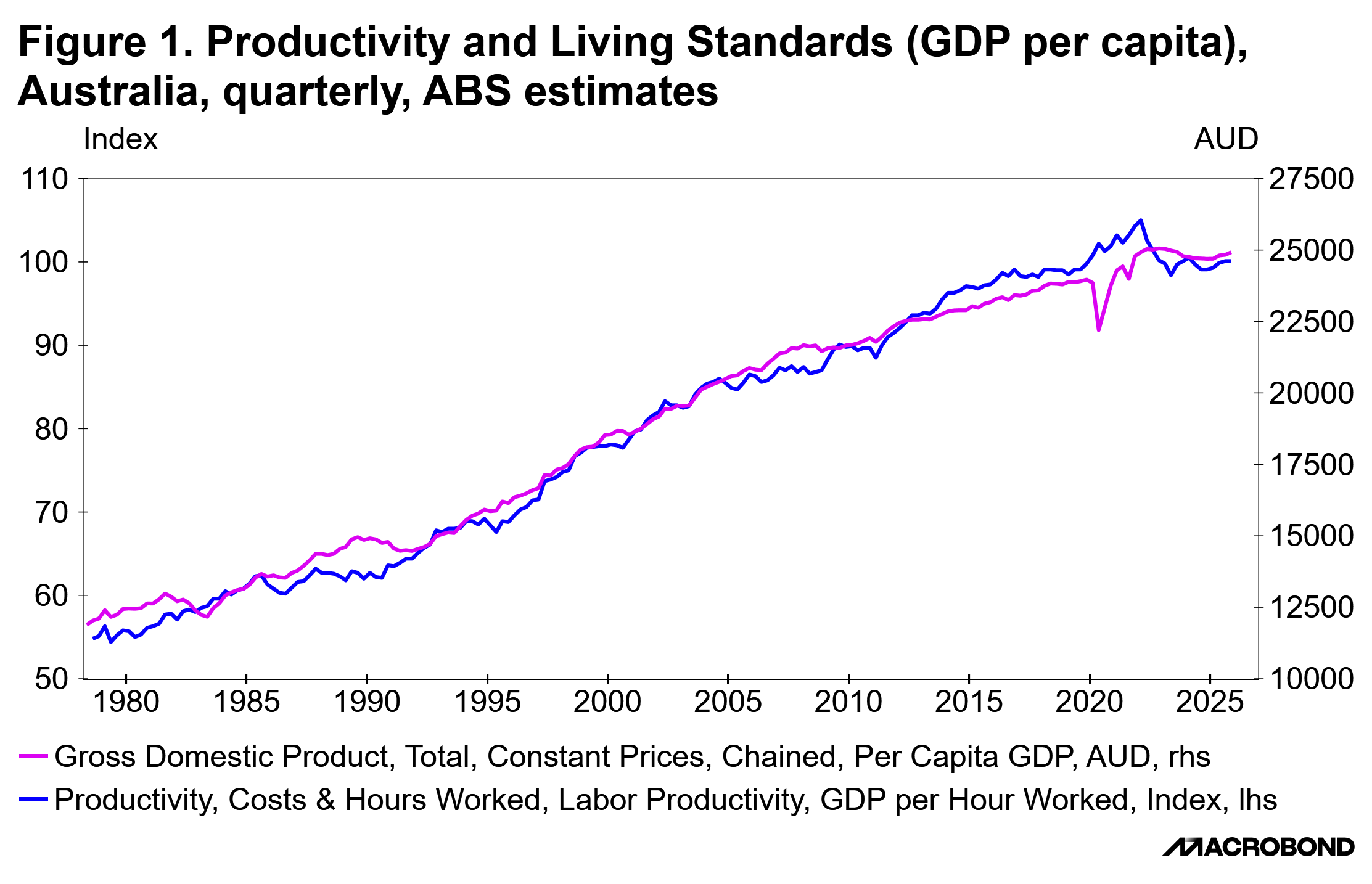
Over long periods, the link between productivity and living standards is clear (Figure 1). As Danielle Wood notes, Australians today enjoy far higher incomes, shorter working hours and better health outcomes than previous generations, largely because productivity has increased over time.
In other words, productivity growth is what allows an economy to deliver sustainable increases in real wages and living standards.
What happens if wages rise faster than productivity?
If wages increase faster than productivity across the economy, businesses face higher labour costs without a corresponding increase in output. That typically leads to one of two outcomes:
- Higher inflation – firms raise prices to cover higher wage costs.
- Higher unemployment – firms reduce hiring or cut jobs if they cannot pass on higher costs.
In practice, economies can experience both at the same time, the phenomenon known as stagflation.
This is not simply theoretical. Australia experienced this dynamic during the 1970s and early 1980s.
Lessons from Australia’s wage-price spiral
During the 1970s, Australia saw rapid wage increases driven by a combination of strong unions, centralised wage-setting arrangements, and attempts to protect living standards amid global economic turmoil.
However, productivity growth did not keep pace with these wage increases.
The result was a classic wage-price spiral. Businesses raised prices to cover higher labour costs, which then triggered further wage demands as workers tried to maintain their purchasing power. Inflation surged into double digits, and unemployment rose significantly by the early 1980s.
Australia eventually restored stability through major economic reforms. These included:
- the Prices and Incomes Accord between unions and government
- financial market deregulation
- trade liberalisation
- competition policy reforms
- labour market changes that gradually linked wage outcomes more closely to productivity
These reforms helped reset the relationship between wages and productivity and contributed to Australia’s stronger economic performance from the mid-1990s to before the pandemic.
Why productivity is back in the spotlight
Today, productivity growth in Australia has slowed markedly. Policymakers are increasingly concerned that without stronger productivity growth, it will be difficult to deliver sustained improvements in real wages and living standards.
This is why productivity has become a central focus of economic policy discussions. Reforms that encourage investment, innovation, skills development and efficient regulation can all help lift productivity.
Importantly, this does not mean wages should stagnate. Rather, it highlights that the most durable path to higher wages is an economy that produces more value per worker.
The enduring economic lesson
The productivity–wage link is one of the most robust findings in economics. Over the long run, workers are paid roughly in line with the value they produce.
When productivity rises, economies can sustain higher wages, higher profits, and improved public services simultaneously. When productivity stalls, those gains become much harder to achieve.
As policymakers debate how to lift living standards in the years ahead, this lesson remains as relevant as ever: strong productivity growth is the foundation of sustainable wage growth.
Published on 6 March 2026. For further information, please contact us at contact@adepteconomics.com.au or call us on 1300 169 870.