From Discipline to Complacency: Changing Attitudes to Public Debt
Public debt was once politically toxic. Governments feared deficits, voters worried about borrowing, and treasurers celebrated fiscal discipline. Today, that instinct has weakened. Debt is no longer at the forefront of public debate. What changed?
In a recent episode of the Economics Explored podcast (embedded below, along with the YouTube video), I discussed this issue with my colleagues John Humphreys of the Australian Taxpayers’ Alliance and Professor Sinclair Davidson of RMIT. Our conversation explored whether Australia and other advanced economies have shifted from discipline to complacency regarding public debt.
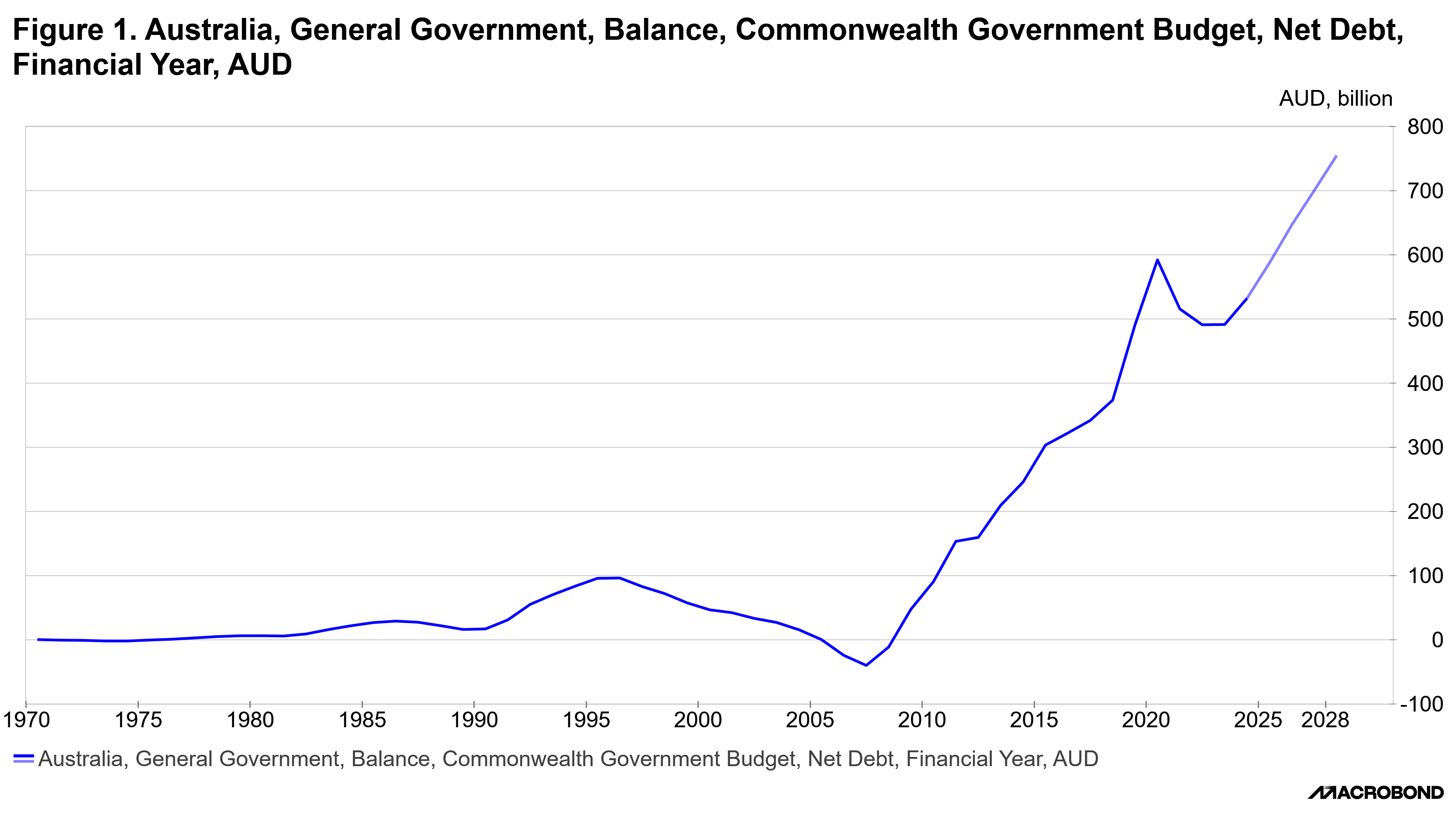
The 20th anniversary last week of then-Treasurer Peter Costello declaring Australia net debt-free in 2006 inspired this conversation. It is sobering that, twenty years on, net debt is approaching $600 billion and is on track to reach even higher levels (Figure 1). Furthermore, there are hundreds of billions of dollars of state debts that, in an extreme situation, the federal government may need to assume some responsibility for.
The “old-time fiscal religion”
For much of the late 20th century, there was what Nobel laureate James Buchanan called an “old-time fiscal religion.” Governments were expected to balance their budgets over the economic cycle. Debt was something to be used sparingly, typically in response to wars or deep recessions.
In Australia, this mindset was evident in the Hawke-Keating and Howard-Costello eras from 1983 to 2007. Economic reforms were accompanied by a strong emphasis on fiscal responsibility. Politicians knew that persistent deficits could cost them at the ballot box.
This wasn’t just about economic theory. It was also about public attitudes. Voters had a strong instinctive dislike of government debt. Even if they didn’t fully understand the nuances of fiscal policy, they were wary of governments “living beyond their means.”
The shift toward complacency
Today, things are very different. Governments across the world have accumulated significantly higher levels of debt, particularly since the global financial crisis and the COVID-19 pandemic.
In Australia, while debt levels remain lower than in many comparable countries, the trajectory is upward. Worryingly, the political and public reaction to rising debt appears muted.
Why has this happened?
One explanation is that economists themselves helped change the narrative. Over time, the profession has emphasised that debt can be appropriate in certain circumstances: for example, to support the economy during downturns or to finance productive public investment.
This is a valid point. Not all debt is bad. But an important nuance may have been lost. While debt can be useful, it cannot grow indefinitely without consequences (e.g., credit rating downgrades and higher borrowing costs), and it is not costless in the short term either.
Indeed, the federal government’s net interest expense is nearly $30 billion annually (according to the Australian Government General Government Sector Monthly Financial Statements for March 2026). That’s a direct hit to the budget. It’s money that’s paid to bondholders, and it can’t be spent on health, education, defence, or other priorities.
Why attitudes matter
Changing attitudes to debt have real consequences. If voters no longer penalise governments for running deficits, the political incentives shift. Governments may be more willing to spend without clearly identifying how that spending will be funded. Over time, this can lead to a steady accumulation of debt.
As we discussed on the podcast, this may not trigger an immediate crisis. Australia is not on the brink of a fiscal emergency. However, debt is a “slow-burning” issue. It becomes more problematic over time, particularly if economic conditions deteriorate or interest rates rise.
There is also the issue of intergenerational equity. Borrowing today effectively shifts part of the cost of current spending onto future taxpayers. That may be justified in some cases, where future generations will benefit from capital investments today, but it should be a conscious decision, not an unintended consequence of complacency.
Rebuilding fiscal awareness
So what can be done?
First, there is a need to improve economic literacy. While not everyone needs to understand the finer points of public finance, a basic awareness of how government budgets work is essential in a democracy. Economists must think about how to better communicate the ongoing costs of debt.
Second, there may be value in rediscovering some of the old instincts around fiscal discipline. While the “old-time fiscal religion” may have been too rigid at times, it served an important purpose in constraining excessive borrowing.
The challenge is to strike the right balance: recognising that debt can be a useful policy tool, while avoiding complacency.
You can listen to the full discussion in the embedded podcast audio above or watch the conversation on YouTube.
Gene Tunny, Director of Adept Economics
Published on 27 April 2026. For further information, please contact us at contact@adepteconomics.com.au or call us on 1300 169 870.